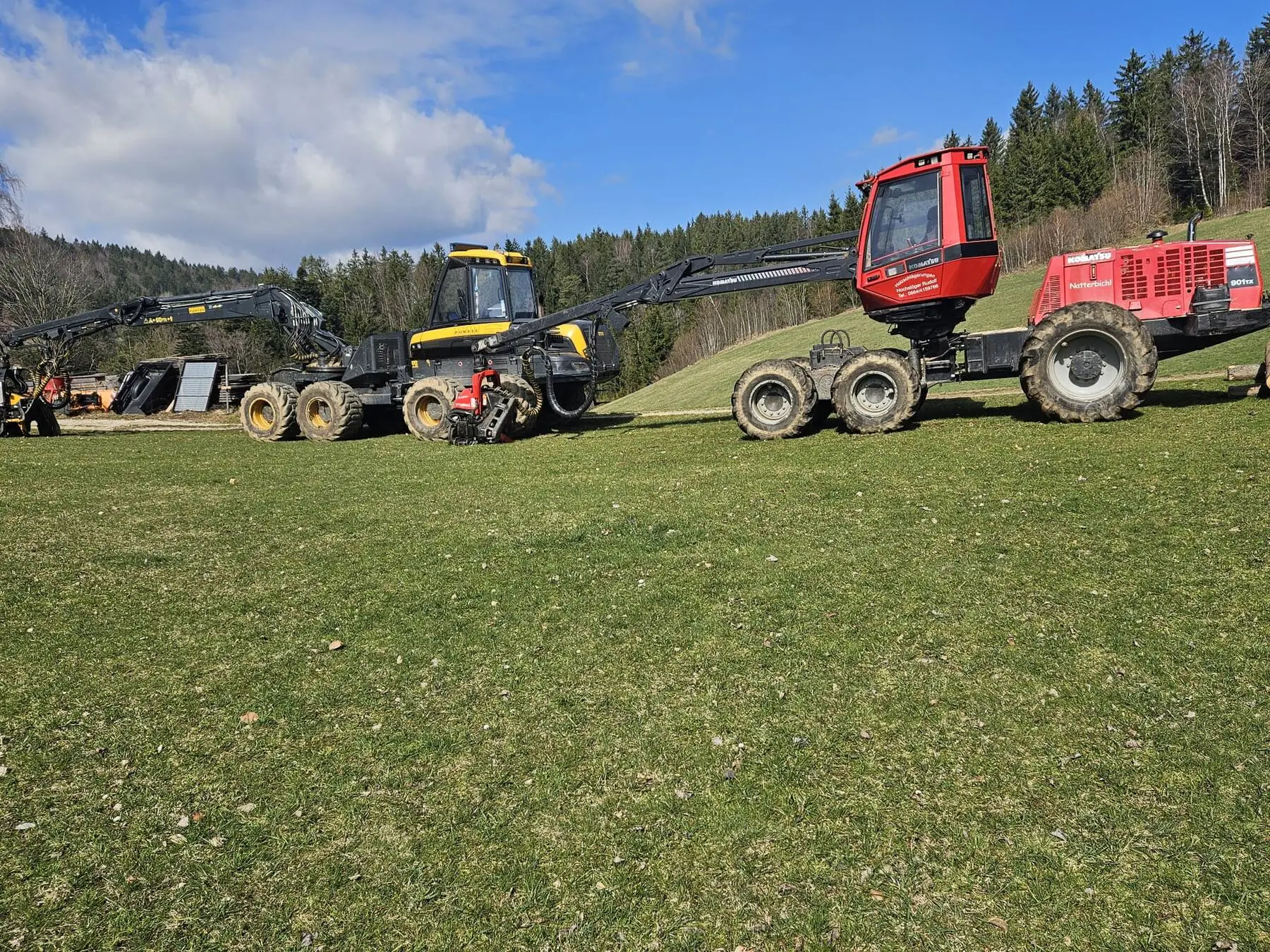
Your guide to timber harvesting and forest care
Clearly explained: the key questions around felling, thinning, damaged timber and sustainable forest use — from the everyday practice of a forestry business in the Mostviertel and Mühlviertel.
What to know about felling and forest care
In this guide we answer the questions forest owners ask most often: when a thinning is worthwhile, when the harvester or the chainsaw is the better choice, what a harvest costs roughly, and how to handle damaged timber correctly.
Every forest is different, and the right decision always depends on the stand, the terrain and your goals. The sections below give you a sound orientation. For a binding assessment, it is best if we look at your stand on site.
When should you thin?
Thinning is the most important care measure in a managed forest. It selectively removes weaker or poorly formed trees so the remaining future trees get more light, water and nutrients.
As a rule of thumb, a stand is thinned once the crowns clearly touch and the trees compete with one another — depending on the species and site, usually every few years. A tended, opened-up stand grows more stable, is less prone to snow and wind breakage and ultimately yields more valuable timber.
Thinning regularly not only produces a steady supply of usable thinning timber, it also spreads the risk: instead of one single large intervention, the forest stays productive for the long term. The best time can be planned well; on dry or frozen ground the machines work especially gently.
Our services at a glanceFully mechanised or manual harvesting?
Whether the harvester or the chainsaw is used depends on the stand, the quantity and the terrain. Both have their place — often the methods even complement each other on the same job.
Fully mechanised harvesting with the harvester is quick, even and safe for the operator. It plays to its strengths on areas above a certain size, where the machine fells, delimbs and cross-cuts into assortments in one pass — from the thin thinning stem to strong old-growth timber.
Manual felling with the chainsaw is the better choice where the machine cannot or should not go: for single trees, in very tight spots, around particularly worthy neighbouring trees or in special cases. In practice we combine the two so your timber leaves the forest as gently and economically as possible.
To our machinesWhat does felling cost?
Fixed prices cannot seriously be quoted across the board, because every stand is different. The example figures below do give you a feel for the scale, though.
Manual felling with the chainsaw is around €25 to €30 per hour, for example. Moving the machines to smaller jobs under about 300 solid cubic metres carries a flat fee of roughly €100, because the harvester and equipment first have to be brought to the site. Mechanised felling starts at roughly €15 per solid cubic metre.
All of these figures are expressly non-binding orientation values — we only ever make the exact quote after an on-site visit, once we know the stand, the quantity and the terrain. On request the costs are settled directly from the timber proceeds, so you pay nothing up front.
Estimate the costs with the calculatorHarvesting on steep slopes
Steep terrain is no reason to rule out a job either. Our harvesters work up to a slope of around 60 degrees — gently on the soil and without tearing up the hillside over a wide area.
On a steep slope, access is decisive. Along carefully laid-out extraction racks the machine moves in fixed tracks through the stand instead of driving back and forth. That keeps track damage and soil compaction low and protects the roots of the remaining trees.
Especially on broken terrain, experience pays off: we plan the felling direction and the forwarding so the timber reaches the forest road safely and with as little ground contact as possible. Whether your slope is best harvested mechanically or manually is something we clarify during the site visit.
More on forwarding and stagingBark beetle and damaged timber — act quickly
With beetle infestation, windthrow or snow breakage, every week counts. Damaged timber quickly loses value, and infested trees are a danger to the healthy remaining stand.
In warm weather the bark beetle spreads rapidly: individual infested trees can turn into a whole beetle nest within a short time. Getting infested and broken timber out of the forest quickly interrupts the reproduction and limits the damage — for your own stand and for your neighbour.
It is also important to haul the timber out quickly or to store it far enough away from the stand, so the next beetle generation does not simply fly out again. We process damaged timber promptly and stage it cleanly at the road — talk to us early in the case of beetle or storm damage.
More on storm and beetle damageSustainable forest use and reforestation
Managing sustainably means not harvesting more than grows back. Anyone who plans their use for the long term keeps a healthy, productive forest permanently.
As a rule of thumb, a hectare of forest in Austria grows back around 7 solid cubic metres of timber per year on average (a guide value from the Chamber of Agriculture). This figure is a good basis for gauging how much timber you can remove regularly without eating into the substance of your stand.
After a larger harvest, sustainable management also includes regeneration — whether by natural regeneration or targeted reforestation with site-appropriate, climate-fit species. That keeps the forest stable and productive over generations. We plan every felling with an eye on the stand that remains.
How we work in your forestQuestions and answers from practice
Briefly answered: what forest owners ask most often about harvesting and forest care.
When is the best time for a thinning?
Thinning is done once the crowns clearly touch and the trees compete with one another — depending on the species and site, every few years. For the actual work, dry or frozen ground is best, because the machines then work especially gently. So it is best to plan a thinning with a little lead time.
From what area is the harvester worthwhile?
There is no fixed minimum. Single stems and small quantities are done by Rudi with the chainsaw; for larger areas the harvesters come out. For smaller jobs under around 300 solid cubic metres a transfer flat fee of about €100 applies, because the machines first have to be brought to the site.
What does felling cost roughly?
As a rough guide: manual felling is around €25 to €30 per hour, mechanised felling starts at about €15 per solid cubic metre, plus the transfer flat fee on small jobs. These are non-binding example figures — we make the exact quote after an on-site visit.
Can steep slopes be harvested mechanically?
Yes. Our harvesters work up to a slope of around 60 degrees. Along fixed extraction racks the machine moves gently through the stand instead of driving over the whole area. Whether your slope is best harvested mechanically or manually is something we clarify during the site visit.
How quickly does beetle timber have to leave the forest?
As quickly as possible. Infested trees lose value fast, and in warm weather the bark beetle spreads quickly to healthy neighbouring trees. Processing and hauling beetle timber out promptly interrupts the reproduction and limits the damage. In the case of beetle or storm damage, it is best to get in touch early.
In which season is felling carried out?
In principle all year round, but jobs depend on the season and the weather. On dry or frozen ground we work especially gently on the soil. Because the lead time after your confirmation is around seven working days and slots are in seasonal demand, it is best to enquire in good time.
How much timber can I remove sustainably?
As a rule of thumb, a hectare of forest in Austria grows back around 7 solid cubic metres per year on average. Roughly orienting your harvest to this growth preserves the substance of your stand and keeps things sustainable. The exact amount depends on species, age and site — we assess that together during the site visit.
Questions about your forest?
Whether thinning, beetle timber or a larger harvest — tell us about your stand. We are glad to advise you and will make you a non-binding offer.